Caro had invited me to a cabaret show about Marlene Dietrich.
Why, though? Surely she must know someone who is an actual fan of Marlene Dietrich? Or at least somebody who can distinguish Marlene Dietrich from Greta Garbo without checking Wikipedia? Right. Garbo is Swedish. Moving on.
Well, I wasn’t going to turn down an evening out with Caro, who has (as well as a delightful personality) impeccable cultural and musical taste. The tickets had been a birthday present from her mom; the good-taste apple doesn’t fall far from the tree. So I smudged on my trusty Ruby Woo and headed west on the U-Bahn. Whatever Caro’s mother had picked out for us was going to be better than Netflix.
The show in question was called, simply, Marlene. Caro and I made our way to the Renaissance Theater in Charlottenburg. We hugged our coats close to us and stumbled into a smallish wood-paneled building. I could already feel that we were in a different world from Prenzlauer Berg, where both of us live: the inner West of the city always blows a combination of roughness and glamor into my face, particularly in the winter, when red velvet and chandeliers actually mean something.
My first surprise was that, instead of the usual blasé twentysomething ushers, the Renaissance Theater was staffed by white-haired women dressed nattily in bright red. Sharp but friendly, friendly but sharp, not a one of them was under seventy. I heard one of them call one of the others “Hildegard” so that’s the generation we’re talking about.
My second surprise came once I heard the voice of the actor playing Marlene Dietrich. Yes, actor.
I’d seen a man’s name, Sven Ratzke, on the theater website, but foolishly I didn’t quite put two and two together: Marlene Dietrich was portrayed by a towering, lanky man. He was in drag, wearing a wig and a silk robe, but forget what you know about “drag” in the RuPaul sense. No over-the-top makeup or exaggerated femininity. Ratzke was simply playing a character who happened to be a woman. An actor might take on a role of someone older, younger, disabled, a different race. He was a woman tonight, that was all.
I felt a twang of annoyance: why is a man taking over the story of a woman? But here we were. I settled in anyway, ready to give Ratzke a try.
The first act showed Marlene getting ready for a cabaret performance. Her hair was unkempt, she fluttered and flapped around her dressing room berating both her assistant and the piano player who kept up a background accompaniment to the entire show. She was depicted as old here, I’d say, I don’t know, seventy? Ratzke as a funny, tough, bolshy older woman. She reminded me both of the white-haired ushers and of my own grandmother.
With one big difference: Marlene was horny. Very horny. If the real Marlene had been around today, she would have been described as queer: she had frequent lovers of both genders, and her velvet-asphalt contralto voice and iconic high-waisted flowing pants gave her a androgynous air.
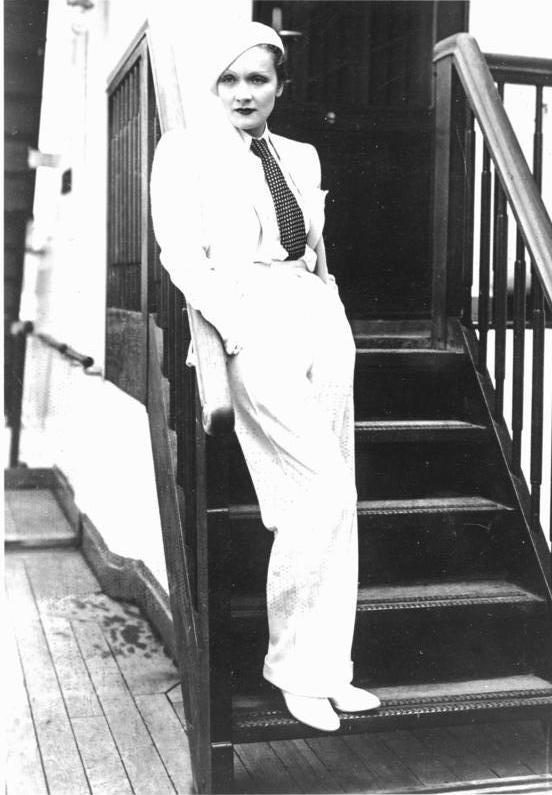
Image: Wikimedia Commons, Bundesarchiv
My initial resistance to seeing a man occupy the voice and persona of a famous woman evaporated. This was a woman who would have loved having a man try on her body and image – that much I had learned about Marlene the first act.
At the intermission, over glasses of prosecco and under the watchful eye of the ladies in red, I said to Caro that I was really enjoying the play so far, but what about the songs? Wasn’t this supposed to be a cabaret? I really wanted to hear Marlene sing. In the second act, I got my wish. The lights came up on a transformed Marlene: glammed up in ecru satin, her bedhead replaced with shimmering finger curls, leaning against a vanity-lit heart-shaped mirror twice her height.
She began to sing. She crooned songs that apparently everyone else in the theater knew, the same way that in the USA many people would be able to hum along with “At Last” or “God Bless the Child”. But Marlene’s classics were all new to me. As the rest of the audience nodded along, heads tilted to the side, maybe even mouthing the words or humming despite themselves, I was listening for the first time.
Here they are, these gorgeous classics, if you, like me, are also newer to la Dietrich.
But then Ratzke, Marlene, began a song that (to Caro’s utter confusion) made me start sobbing. Not quietly, either. I sat rapt with tears spilling down my cheeks, Caro’s hand on my arm.
“Sag mir wo die Blumen sind,” Marlene sang.
Tell me where the flowers are.
It was a stunning translation of a song I could have sung along with in English. The song is more than familiar – it lives in my bones. Any American who loves folk music and protest music would say the same.
Where have all the flowers gone?
I first heard it watching Peter, Paul, and Mary sing it in concert on a PBS special. “This one is great,” said my mom, “it’s a classic sixties song." She sang along to this one, even though I rarely heard her sing. I liked the song, too – I was a school-age kid, but I enjoyed the feeling of really understanding the meaning of a serious adult song. The circular structure and repetition has a simple genius to it. Of course, the composer of the song was our national treasure Pete Seeger.
After the show, Caro said to me, “I’m glad you liked that song, ‘do you know where the flowers are.’ It’s a classic German song.”
“NO it is NOT!” I almost yelped. “Pete Seeger wrote it!”
“Pete who?” (I suppose this is like me saying “Marlene who?” to her.)
“It’s called ‘Where have all the flowers gone!’” Caro didn’t believe me. Second trip to Wikipedia today: this time I was right.
“How can that be though?” she asked. “I heard the song so many times, every kid knows it since Marlene made it famous. We all think it’s German.”
I started to do a little research and found that the song is inextricably linked to Marlene for good reason. She sang it while touring Israel. Yes, she sang in German. In Israel. In 1966.
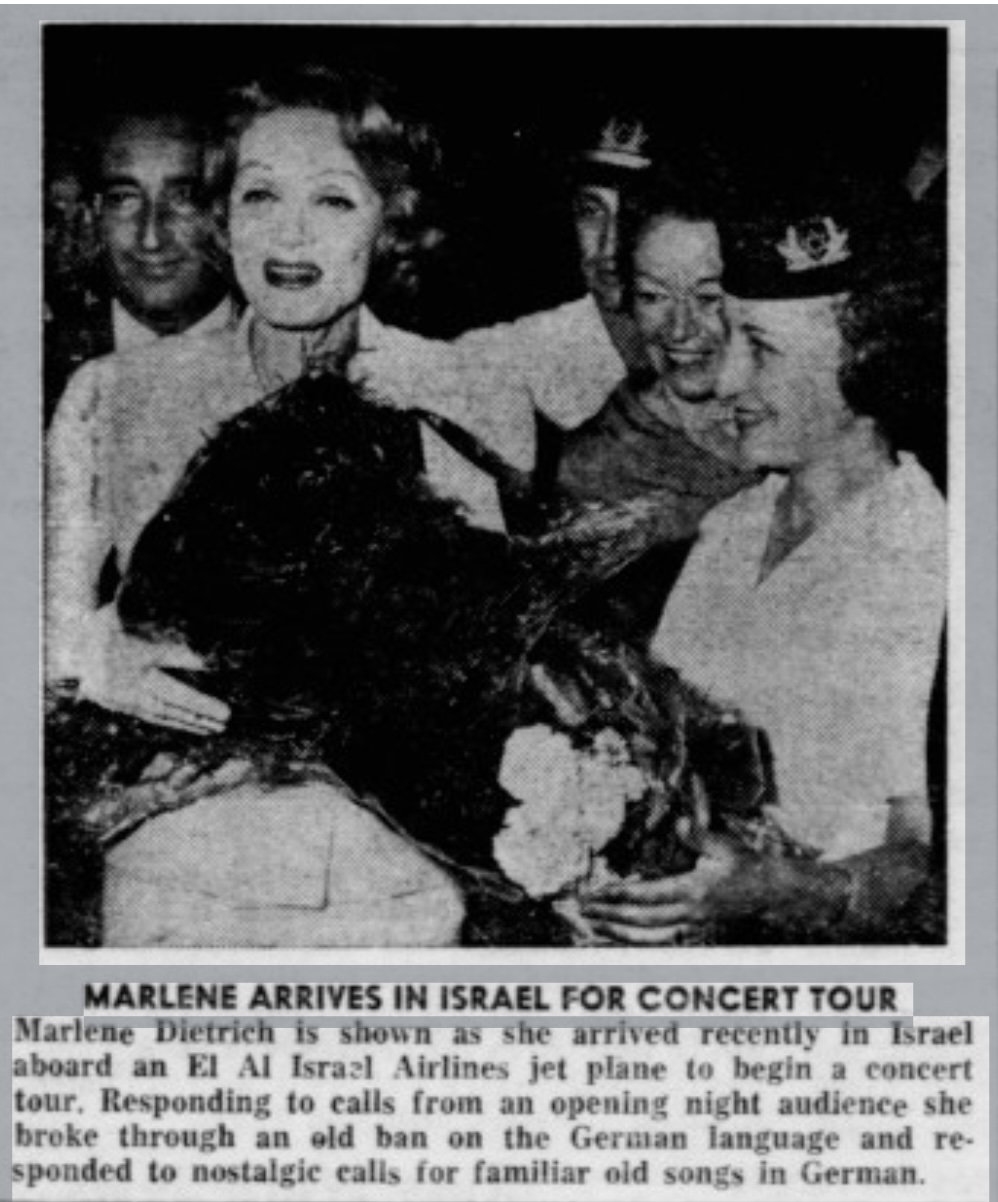
Image: The Jewish News of Northern California, Volume 110, Number 31, 29 July 1960
Marlene was the first artist to perform publicly in German in Israel. Given her unwavering opposition to the Nazi regime, it made sense that she was the one who could break this taboo.
She had fled Germany in 1937, once the rise of the Nazis was all but assured. She arrived in the US, applied for US citizenship, and renounced her German citizenship. She performed for Allied troops, she helped raise money for the Allied war effort, she made it abundantly clear that she was ashamed of Germany, thought Germany was better than this, wanted nothing to do with Hitler. “Hitler is an idiot,” she said in a wartime broadcast from Britain – in German, so the German soldiers could understand. “Boys, don’t sacrifice yourself for this crap.”
Germany named her as a traitor to the fatherland, of course. After the war, many Germans received Marlene back rather coolly. Crowds even protested outside her concerts: Marlene Go Home! But they couldn’t keep up much of a resistance: she was pretty clearly right and they were wrong. Also, don’t forget, she remained a generational musical talent with a magical sexy magnetism, which didn’t hurt. So she enjoyed a successful last chapter as a touring cabaret singer in her later years – but always with a political bent, spreading her anti-war, anti-fascist message while being stubborn, glam, and what we would now call queer. Though the US awarded her the Presidential Medal of Freedom, Germany didn’t give her any official recognition until 2002, after her death.
So there I sat, spellbound by a singer with a beautiful voice singing a familiar song. I felt appreciation and understanding for the tough old lady from the first act, who made sass into politics. I was transfixed by the power of a man performing as one of Berlin’s most famous women, how this has been illegal and taboo, and may again be illegal and taboo, but also how Berlin has been a gender and sexuality sanctuary in the past and hopefully can hold on to these memories long enough to remain one.
But when Marlene started to sing Pete Seeger’s song, that was when I felt many pieces of me fly towards each other across the Atlantic and start to vibrate in harmony.
This is why I was crying: I learned that night that my two countries share a song. People in both of these two large and deeply imperfect world powers have these words in their bones and feel that the song belongs to them and speaks to them. I was crying because I was thinking of all the times Germans and Americans who know the song aren’t paying attention to it. And I was crying for joy – because Pete and Marlene’s song is so powerful in both my countries that maybe it could help us.