Our older daughter was diagnosed with diabetes type 1 in 2022. She was two years old.
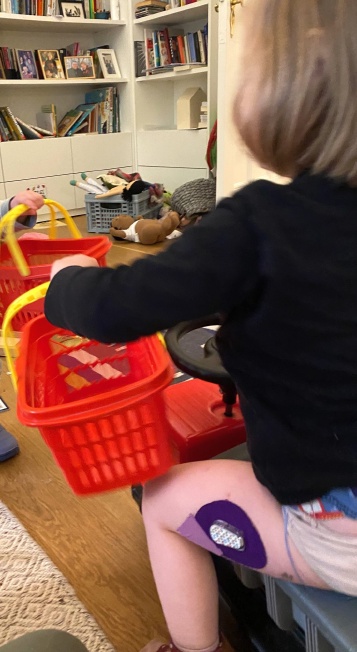
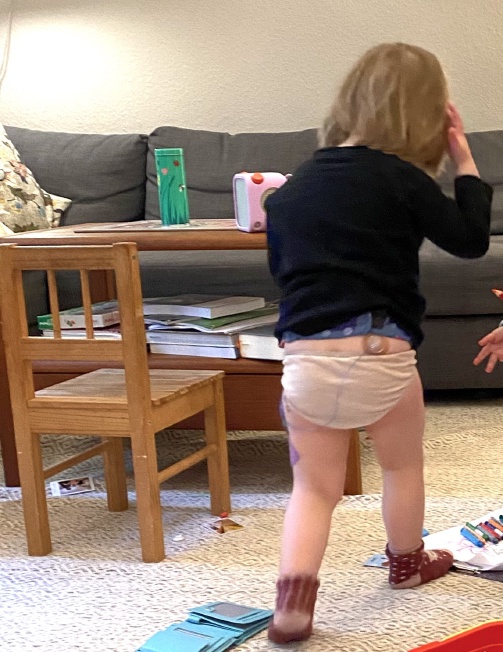
“Amazing what technology can do these days,” I heard over and over. It’s really true. Above, she is wearing her first sensor, the Dexcom G6, and the YpsoPump insulin pump. The sensor and the pump communicate with each other via her phone, which runs an algorithm called CamAPS (Cambridge Automated Pancreas System). It makes sure she gets more insulin when her blood sugar is high, and less when it’s low. Incredible, isn’t it?
We can be grateful for this technology that keeps her alive (and for the insurance system that pays for it), and also admit that this disease is an absolutely massive pain in the ass. For us, for her, for everyone.
From the beginning, we focused on the psychological aspects of her treatment as much as the physical ones. We wanted her to feel safe and happy and at ease around food, even while we measured every gram of carbohydrate intake. We wanted her to feel that her medical devices were a bonus part of her beautiful body.
I started looking for books about diabetes before we even left the hospital. In English or in German, I didn’t care. The hospital suggested some books. We got a couple for free.
But they weren’t what I wanted. They were ABOUT diabetes.
“Max doesn’t feel well. He’s peeing a lot. He goes to the doctor. Max has diabetes! Now he needs an insulin pump. Here’s what that means. But guess what? He can still play soccer. The end.”
This is the whole plot of every book about diabetes.
It’s super boring. It also shows a profound misunderstanding of what it’s actually like to have diabetes. Having diabetes doesn’t mean thinking about it all the time; it means NOT thinking about it most of the time, but every now and then – surprise! – you need to stop what you’re doing and think about it again.
It’s Halloween, but with diabetes.
It’s your birthday, but with diabetes.
You got a new bike, but with diabetes.
You’re going on vacation, but with diabetes.
Your friend won’t play with you anymore and you don’t know why, but with diabetes.
You’re trying new foods, but with diabetes.
You lost your teddy bear – and, to top it all off, you have diabetes.
Life with diabetes means doing all that completely normal kid stuff – with a whole extra layer on top.
I didn’t want a diabetes book! I wanted our normal books to have diabetes in them.
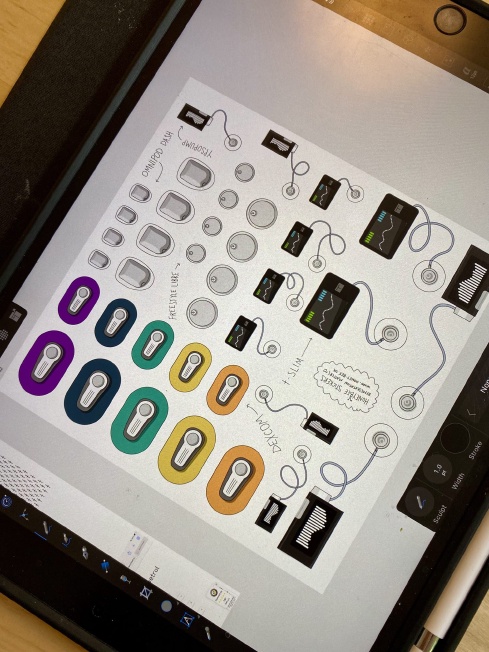
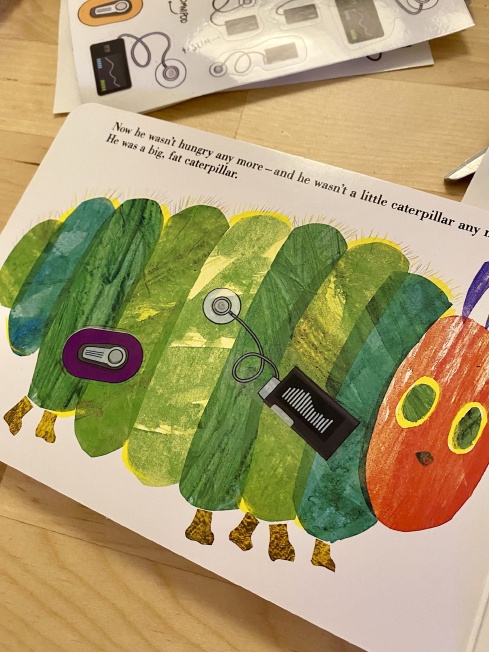
So I made these stickers. I designed them in Affinity Designer on the iPad.
I got them printed on transparent sticker paper.
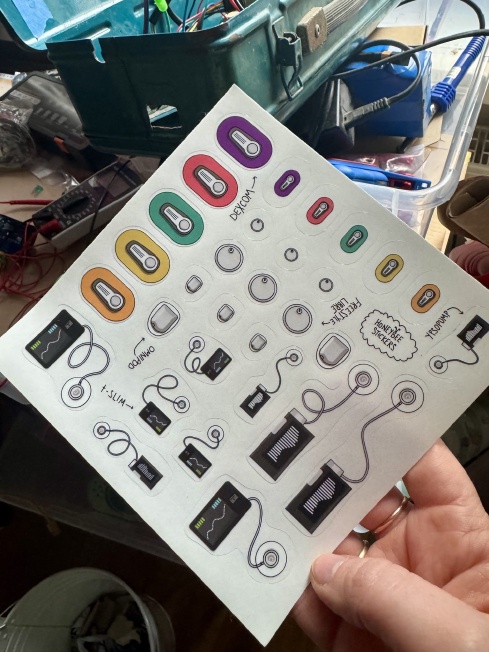
And I gave them to our daughters, ages 1 and 2.
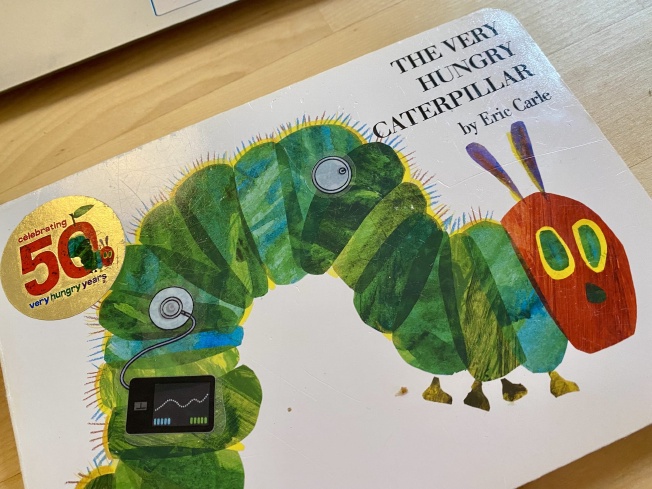
Shortly afterwards, the Very Hungry Caterpillar got diabetes.
We began to read the book quite differently. If he has diabetes, that means he needs insulin for all that fruit. Also the cupcake and the lollipop. But not for the sausage, the cheese, or the nice green leaf.
My plea for authors and illustrators who want to be more inclusive: just stick the disabilities in the mix. Let them hum along in the background, part of the texture of the world. Sometimes they’ll be part of the story, sometimes they won’t.
Disabilities aren’t really their own topic. They don’t need special books and media. They’re never the only thing, but they’re always there.
These stickers are my little way of making peace with that.